The lights in half the house have gone out again, and it’s the same fuse. You’ve pulled the carrier out, rewired it, pushed it back in, and a week later it’s gone again. That repeat is the clue. Here’s what it means, and why rewiring the fuse one more time won’t fix it.
A fuse that keeps blowing is doing its job: something on that circuit is drawing too much current, shorting out, or overheating at a loose connection. Rewiring the fuse only puts the same weak point back, and using heavier fuse wire removes the protection altogether. Unplug what’s on that circuit and note what was running when it blew. If it blows with nothing plugged in, or the fuse carrier is scorched or hot, leave it out and call. On an old fuse board, the lasting fix is usually a switchboard upgrade with circuit breakers and safety switches.
“Leave the fuse out and call if”
- The fuse carrier or the board around it is scorched, cracked, or melted.
- You can smell burning, or hear crackling from the fuse box.
- The fuse blows again the moment it goes back in, with nothing switched on.
- Call 0450 406 450, 24/7. If there’s smoke or flame, get everyone out and call 000.
What a Blowing Fuse Is Telling You
A rewireable fuse is a short length of thin wire sized to melt before the cable in your walls overheats. When it melts, it’s protecting the wiring. It blows for one of four reasons:
- Overload. Too much running on one circuit at once, like a heater, kettle, and microwave on the same old power circuit.
- A short circuit. Damaged cable or a faulty fitting lets current take a shortcut. The fuse goes instantly, often with a bang.
- A faulty appliance. A failing element or motor pulls too much current or shorts internally.
- A loose or worn fuse carrier. Old carriers lose their grip on the contacts. The loose joint heats up and melts the fuse wire even when the circuit isn’t overloaded.
Why Heavier Fuse Wire Is Dangerous
It’s the oldest shortcut in the book: the fuse keeps going, so someone puts in thicker wire, or doubles it up, or worse, a nail. The fuse stops blowing because it can no longer protect anything. The cable behind the wall now carries whatever the fault pushes through it, and old rubber or cotton covered cable doesn’t cope with that heat for long.
Fuse wire has to match the rating stamped on the carrier, and even the right wire only puts the same weak point back. If a fuse blows more than once, the fault is still there.
Safe Checks Before You Call
You can narrow it down without touching anything inside the fuse box:
- Unplug everything on the circuit that went dead, and note what was running when it blew.
- Leave the fuse out until you’ve decided what to do. Don’t keep putting it back in to test.
- If one appliance was on each time, stop using it and have it checked.
- Look at the carrier you pulled out, without poking at the board: brown marks, melted plastic, or a burnt smell point to a heat problem at the board.
If you have breakers and safety switches rather than fuses, the checks are different; see why breakers and safety switches keep tripping.
“What Not to Do”
- Don’t fit heavier fuse wire, double it up, or use anything that isn’t fuse wire.
- Don’t keep replacing the fuse and switching things back on to see if it holds.
- Don’t take covers off the fuse box or reach in behind the carriers.
- Don’t drill, scrape, or break any part of an old board or its fuses.
Old Fuse Boards Hide Other Problems
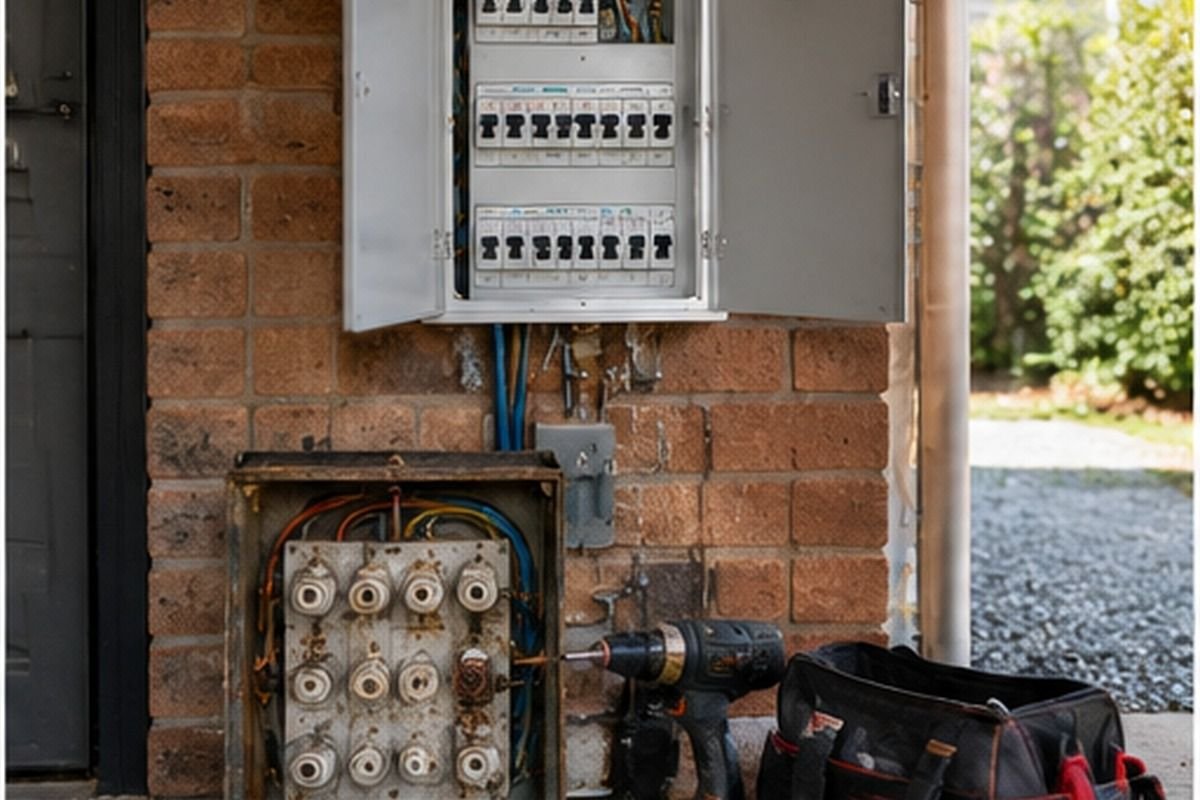
Original fuse boards still turn up in 1950s and 1960s homes around Valentine, Waratah, Jesmond, Lambton and Adamstown. A June 2025 enquiry from Valentine was typical: a 1968 house still on the board it was built with. Those boards carry a few problems beyond the fuse itself:
- No safety switch. A fuse protects the wiring, not the person touching a faulty appliance. Most original fuse boards have no shock protection at all.
- Asbestos. The NSW Government’s asbestos site lists fuses used on 1960s meter boards with asbestos in them, including one type with friable asbestos matting, and backing boards made before 1987 may contain it too.
- No room. Every fuse is in use, so there’s nowhere to add a circuit for air conditioning, an oven, or a car charger.
That’s why nothing on an old board should be drilled, cut, or forced. A licensed electrician knows to treat it as possible asbestos before any work starts.
“Fuse that won’t stop blowing?” Fuse box faults · Switchboard upgrades · Newcastle, Lake Macquarie and Maitland. I’ll find what’s blowing it, make the circuit safe, and give you a written price to replace the old board while I’m there.
Why It Usually Ends in a Switchboard Upgrade
Sometimes the fix is an appliance or one damaged cable. But when the fuse box is original, the electrician who finds the fault will usually recommend replacing it, for three reasons: the board has no shock protection, its fuse carriers are worn, and any new circuit needs space it doesn’t have.
A new board puts circuit breakers and safety switches on every circuit. A breaker trips and resets with a flick, no fuse wire involved, and the safety switch adds the protection a fuse can’t give. Changing a board is licensed work, and in NSW any electrical wiring work needs a licence. If you want to know what it’s likely to cost, see what a switchboard upgrade costs in Newcastle.
“Old fuse boards replaced across Newcastle” Switchboard upgrades · 24/7 for urgent faults · Newcastle, Lake Macquarie and Maitland” Ceramic fuse boards swapped for circuit breakers and safety switches, with old boards handled as possible asbestos and every circuit tested and labelled.
Frequently Asked Questions
Why does my fuse keep blowing?
Something on that circuit is drawing too much current, shorting out, or overheating at a loose fuse carrier. A fuse that blows more than once means the fault is still there.
Can I use thicker fuse wire?
No. Heavier wire stops the fuse from protecting the cable, so the wiring can overheat before anything cuts the power. Fuse wire must match the rating on the carrier.
Why does my fuse blow when I turn on one appliance?
Either the appliance is faulty, or the old circuit can’t carry it. Stop using that appliance on that circuit and have both checked.
Do old fuse boxes contain asbestos?
Some do. The NSW Government’s asbestos site lists fuses used on 1960s meter boards, and backing boards made before 1987, that may contain asbestos. Don’t drill or break anything on an old board.
Do I have to replace my fuse box?
It isn’t automatic, but a fuse box with no safety switch, worn carriers, and no spare space is usually worth replacing once a fault shows up.
Stop Rewiring, Start Fixing
A fuse that keeps blowing is a warning, not a nuisance. Find the cause, leave the fuse wire alone, and think about what the old board is costing you in safety. For fuse box faults and switchboard upgrades in Newcastle, Lake Macquarie, or Maitland, call 0450 406 450.