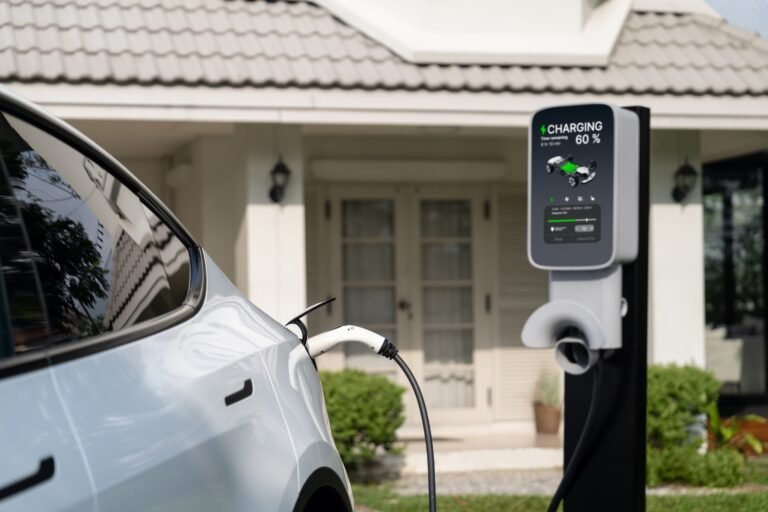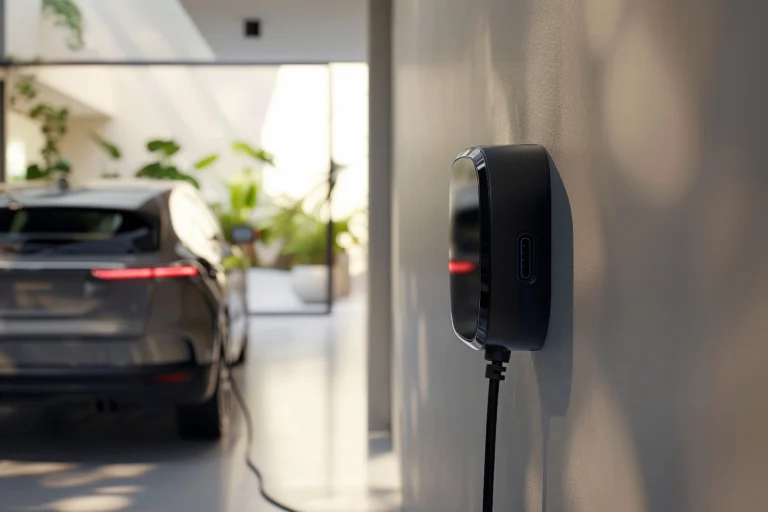
Charging an EV in an apartment car park is possible, but it starts with the owners corporation, not the electrician. The power has to come from somewhere, someone has to pay for it, and the building’s supply has to cope. Here’s the order to do things in, whether you’re in a unit in the Newcastle CBD, Honeysuckle, Merewether or Charlestown.
Yes, you can usually get an EV charger in a strata car park, but the order matters: owners corporation approval first, then a design for the building’s supply, then the install. In NSW, EV charging counts as sustainability infrastructure, so the vote has a lower bar than most common property works. A new “right to charge” law passed NSW Parliament in October 2026 and will stop strata committees unreasonably objecting once it starts, but it isn’t in force yet. Until then, start with the committee, then book an EV charger installation assessment of the car park and switchroom.
Approval First, Then Design, Then Install
- Talk to the strata committee or strata manager and ask how the building handles EV charging requests.
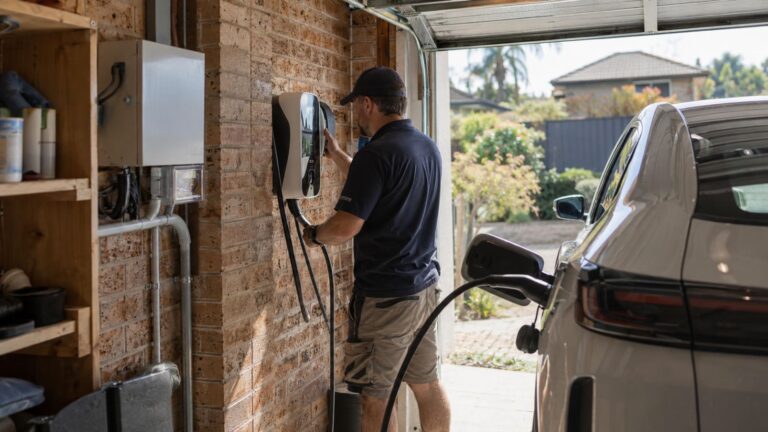
- Get an electrician to look at the car park, switchroom and your unit’s meter so the committee has a real proposal to consider.
- Put the proposal and any by-laws to the owners corporation for approval.
- Once approved, the electrician installs, tests and lodges the compliance certificate, and Ausgrid is notified if the load needs it.
Skipping straight to the install is the most common mistake. Work on common property without approval can end in a dispute with the owners corporation, and you may be asked to remove it.
Getting Strata Approval in NSW
Under current NSW rules, installing EV charging is classed as a sustainability infrastructure upgrade. That replaced the special resolution once needed for this kind of common property work. According to NSW Climate and Energy Action, the resolution passes as long as less than 50% of votes are against it, and the owners corporation needs a 10-year capital works fund that budgets for the work.
The NSW Government also publishes template EV charger motions and by-laws that committees can adapt, which saves a lot of back and forth. A by-law usually covers who owns the charger, who maintains it, how electricity is paid for, and what happens when you sell.
The New Right to Charge Law
In October 2026, NSW Parliament passed strata reforms that give owners the right to install EV charging on their own lot without fear of unreasonable objection from the strata committee. At the time of writing, those changes haven’t started, and the detailed process will be set out in regulations. Until they do, the current approval process applies. If your committee has said no, ask for the reasons in writing and check the commencement date before you go further.
Where the Power Comes From
This is the decision that shapes everything else. There are three common set-ups:
Running from your own meter keeps billing simple, but in many Newcastle blocks the meter room is a long way from the car space, and the cable route has to pass through walls, ceilings and other owners’ areas.
Load Management When Several Residents Want Chargers
One charger rarely troubles a building. Ten can. A 7kW charger running for hours each evening adds up quickly when everyone gets home at the same time. Load management shares the available capacity between chargers, slowing them down when the building is busy, so the main supply never overloads. The NSW Government’s strata guidance notes that whole-of-building systems normally include it.
If the extra load is significant, Ausgrid must approve the increase before connection, and that can take time. Committees that plan for several chargers from the start avoid paying for the same switchroom work twice.
Who Pays for the Install and the Electricity
In most cases, the owner pays for their own charger and its connection. For electricity, NSW Climate and Energy Action lists options ranging from no usage fee to a flat daily fee, a metered rate per kWh, or charging through your own apartment meter. Whatever the building chooses, the payment arrangement has to be agreed between the owners corporation and the owners, and written into the EV charging by-law.
The NSW Government’s strata guidance also covers funding, so it’s worth checking what’s currently on offer before the committee commits to a building-wide system.
What Not to Do
- Don’t run an extension lead from your unit or a common area power point to the car.
- Don’t book an install on common property before the owners corporation has approved it.
- Don’t let anyone without an electrical licence wire in a charger. It’s licensed work, as covered in installing your own EV charger.
- Don’t assume a charger fitted for one owner can later be shared without a new agreement.
What an Electrician Needs to See Before Quoting
A useful apartment EVSE installation quote needs a site visit. Before quoting, I’ll look at:
- The main switchroom and how much spare capacity the building’s supply has.
- Your unit’s meter and board, and the distance to your car space.
- The cable route through the car park, including fire-rated walls and slabs that have to be sealed to suit.
- The strata plan, to confirm what’s your lot and what’s common property.
- Any chargers already installed, and whether the building has load management.
Photos of the switchroom, the meter panel and your car space help a lot before the first visit.
I’ll assess the switchroom, meters and car park, and give the committee a clear proposal it can vote on.
Apartment and unit block EV charging · Newcastle, Lake Macquarie and MaitlandCosts and Timeframes
There’s no single price for apartment EV charger installation. The things that move it most are:
- The distance from your meter, or the building supply, to the car space.
- Fire-rated walls and slabs on the cable route.
- Switchroom upgrades or a new sub-board for the car park.
- Load management, and how many chargers it’s designed for.
- Any Ausgrid approval for the extra load.
For typical house figures to compare against, see EV charger installation cost in Newcastle. The timeframe usually depends more on the strata process than the electrical work: getting a motion onto a meeting agenda, the vote, and any Ausgrid approval. The install itself is usually done in a day or two once everything’s approved. For larger buildings, commercial electrical work can be scheduled around residents.
Single chargers for unit owners and building-wide systems with load management, planned with the strata committee and installed with the paperwork done properly.
Apartment EV charging · Strata car parks · Newcastle, Lake Macquarie and MaitlandFrequently Asked Questions
Can I install an EV charger in my apartment car park?
Usually, yes, with owners corporation approval. EV charging is classed as sustainability infrastructure in NSW, which has a lower voting bar than most common property works.
Can my strata committee say no to an EV charger?
Under the current rules, it goes to an owners corporation vote. A new right to charge law passed in October 2026 will stop committees unreasonably objecting once it starts.
Who pays for the electricity?
That depends on the set-up and the building’s by-law: through your own meter, a sub-meter, a flat fee or a per-kWh rate.
Can I charge from a common area power point?
Not without an agreement with the owners corporation. Common area power is paid for by all owners.
How long does it take to get an EV charger in a unit block?
The strata approval usually takes longer than the install. Once approved, a single charger is typically installed in a day or two, plus any Ausgrid approval time.
Start With the Committee, Not the Charger
Apartment EV charging works best when the owners corporation, the electrician and Ausgrid are lined up before any cable is run. Get the committee talking, get the site assessed, then install. For apartment and unit block EV charging in Newcastle, Lake Macquarie or Maitland, call 0450 406 450.