Newcastle summers are humid, and a bedroom fan is a cheap way to sleep through them without the aircon running all night. There’s already a light in the middle of the ceiling, so it seems obvious that a fan can go in the same spot. Often it can, but a light point isn’t set up for a fan. Here’s what gets checked before the old light comes down.
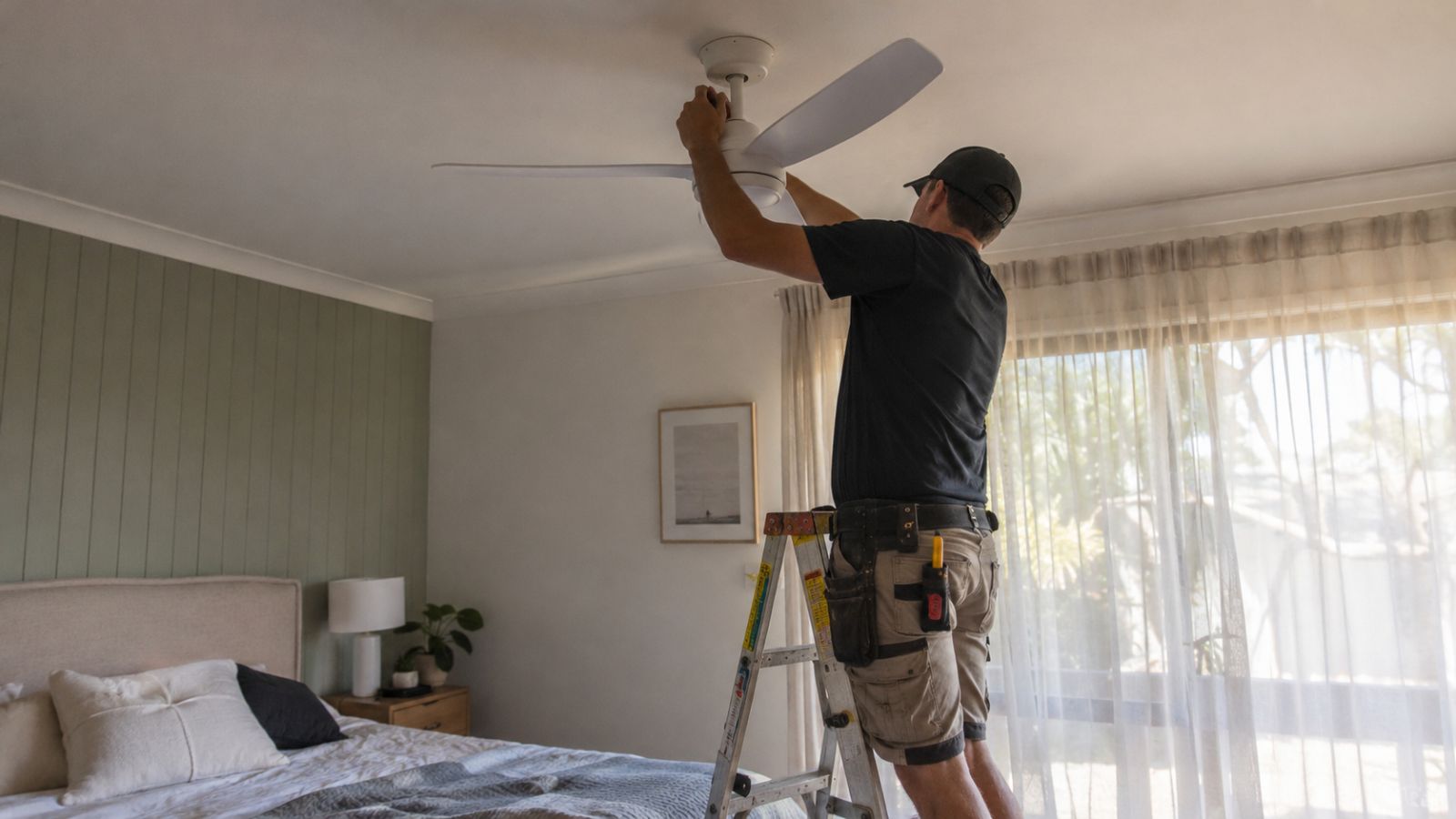
Usually, yes. Most light points can become a fan point, but the old light’s fixing and switch rarely suit a fan as they are. Three things get checked first: whether there’s timber above the light that a fan bracket can be fixed to, whether the ceiling is high enough for the blades to clear 2.1 metres, and how you’ll control the fan and its light separately. Sort those out, and the swap is a normal ceiling fan installation.
Check 1: Can the Ceiling Hold a Fan?
A light fitting weighs a kilo or two and never moves, so it’s usually screwed into a small batten or straight into the plaster. A fan is several times heavier, and when it’s running, it rocks and pulls on its mount all summer. Fan installation instructions require the bracket to be fixed to the house’s framing, such as a ceiling joist, and at least one manufacturer asks for a fixing that holds four times the fan’s weight.
So the first look is in the roof space, directly above the light. If a joist is right there, good. If the light sits between joists, a timber brace goes across the gap for the bracket. Low-pitched roofs and lights under an upstairs floor take more work to reach.
“What Not to Do”
- Don’t hang a fan from the old light’s batten or from plasterboard alone.
- Don’t run a fan from an existing light dimmer. It isn’t made for a motor.
- Don’t reuse the old light’s wiring for a fan without having it checked first.
- Don’t do the wiring yourself. In NSW, electrical installation work must be done by a licensed electrician.
Check 2: Ceiling Height and Blade Clearance
The blades need to be at least 2.1 metres above the floor. A standard 2.4 metre ceiling leaves room for a fan on a short rod, but not much more. Lower ceilings, common in attic conversions and rooms built in under the house, need a close-mount fan that sits tight to the ceiling, or no fan at all. The high ceilings in older Hamilton and Cooks Hill terraces go the other way and need a longer rod.
There’s sideways clearance to think about too. Installation guides typically ask for about 300 mm between the blade tips and the nearest wall or obstruction. That rules out some light points near a wall or bulkhead, unless the point moves towards the middle of the room.
Check 3: Switching the Fan and Light Separately
A light point usually has one on-off switch. A fan with a light needs speed control for the fan and separate on-off for the light. There are three common ways to get there:
- A remote or app control. A receiver in the fan’s canopy handles speed and light, so the existing single switch can stay. It’s the least disruptive option.
- A wall controller. A fan speed control on the wall, usually beside the existing switch, with new cable dropped down the wall cavity.
- Two switches. One for the fan and one for the light, so the light can be turned on without the fan.
Brick internal walls make dropping a new cable harder, and that’s often when a remote ends up being the better choice.
“Bought your fans already?” Ceiling fan installation · Newcastle, Lake Macquarie and Maitland can fit them. Send a photo of the light, the wall switch, and the fan’s model number, and you’ll know what’s needed before I arrive.
Fan With a Light or a Separate Light? Bedrooms and Living Areas
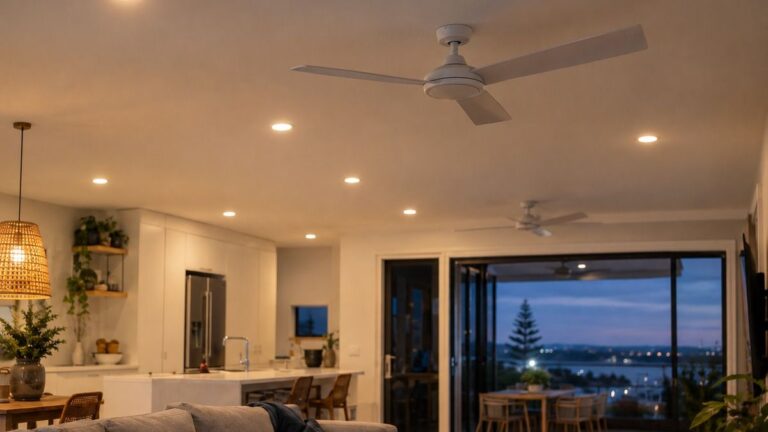
In a bedroom with one light point, a fan with a built-in LED light is the neat answer: one fitting does both jobs. Living areas are different. If the room is lit by downlights and the fan goes in among them, the blades cut through the light and cause a strobing flicker that a lot of people can’t stand.
The fix is to keep downlights out of the blades’ sweep, or make the fan’s own light the main light there. If you’re changing old downlights at the same time, the LED downlight upgrade guide covers that side, and light installation can be done in the same visit.
Coastal, Bathroom and Outdoor Spots Need the Right Rating
A light point on a verandah or in a covered patio can become a fan point, but the fan has to be rated for damp or wet locations. Near the beaches, from Stockton to Swansea, salt air eats through standard finishes quickly, so look for one built for coastal conditions. Bathrooms are a different matter. Fittings near showers and baths must suit their zone, and an ordinary indoor fan doesn’t.
Cost per Fan and How Long It Takes
A Newcastle electrician cost guide verified in October 2026 puts ceiling fan installation at $140 to $380 per fan, with $240 typical. The guide doesn’t list light-to-fan work separately, so what moves the price is the extra work: a brace, new cable for a wall control, or a point that has to move.
With good roof access, a single swap is usually done in a couple of hours. Several fans in one visit, like the seven at a North Lambton home in April, cost less per fan, because the roof-space work and setup are done in one go.
“Ceiling fan installation across Newcastle” Ceiling fans · Lights in the same visit · Newcastle, Lake Macquarie and Maitland. Light points turned into fan points, braced to the framing and set up with the controls you want. Every fan is tested on each speed before I leave.
Frequently Asked Questions
Can you put a ceiling fan where a light is?
Usually, yes. The fan needs a bracket fixed to the ceiling framing, enough height for the blades to clear 2.1 metres, and controls for the fan and light.
How high does a ceiling fan need to be?
The blades need to sit at least 2.1 metres above the floor. On a standard 2.4 metre ceiling, that means a short rod or a close-mount fan.
Can I use my existing light switch for a ceiling fan?
Yes, if the fan runs on a remote or app, because the switch just supplies power. For wall speed control, or a light that works separately, a controller or second switch is added.
Do I need an electrician to swap a light for a ceiling fan?
Yes. In NSW, electrical installation work has to be done by a licensed electrician, who tests it and gives you a Certificate of Compliance for Electrical Work.
Why do my downlights flicker when the fan is on?
The blades are passing between you and the light, which creates a strobing effect. Moving the downlights out of the fan’s sweep, or using the fan’s own light, fixes it.
Check the Ceiling Before You Buy the Fan
A light point is a good starting place for a fan, as long as the ceiling, the height and the switching are sorted first. To have your light points checked or your fans fitted in Newcastle, Lake Macquarie or Maitland, call 0450 406 450.