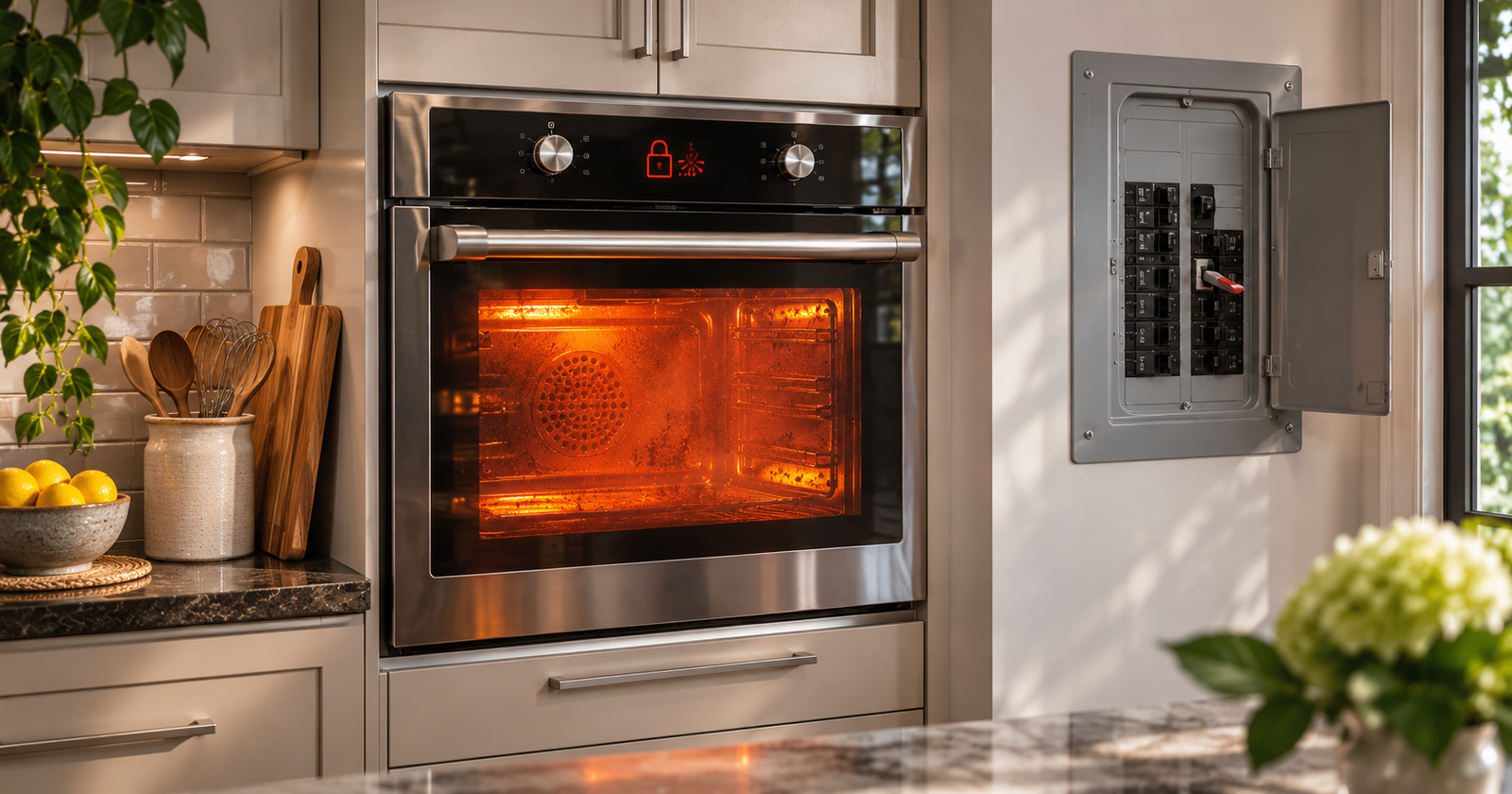
Ten minutes into a pyrolytic clean, the oven goes dead and the power trips. It cooked a roast last night without a problem, so why now? A self-clean runs the oven flat out for hours, and that’s when a weak link in its circuit shows itself.
A pyrolytic clean runs the oven at around 500°C for one to three hours, so the circuit carries close to full load for far longer than during a roast. If the circuit breaker trips, the usual causes are a circuit shared with the cooktop or another appliance, a tired breaker, or a loose, overheating connection at the oven or the board. If the safety switch trips instead, it’s more likely an element leaking current as it heats. Don’t fit a bigger breaker; have the circuit checked through electrical fault-finding so the actual weak link is fixed.
“Stop and call if you notice any of these”
- A burning or hot plastic smell near the oven or the switchboard.
- Scorch marks, or heat you can feel coming off the switchboard without touching it.
- A breaker that trips again straight away when you reset it.
- Leave the oven off at its isolating switch or breaker and call 0450 406 450. If there’s smoke or flame, get out and call 000.
Why a Pyrolytic Clean Exposes Circuit Problems
During a pyrolytic clean, the oven heats to about 400 to 500°C to burn residue to ash, according to CHOICE. A cycle takes about one to three hours depending on the setting; Electrolux, for example, lists 1 hour for light cleaning and 3 hours for a thorough clean.
To hold that temperature, the elements stay on far longer than during normal cooking. The cable, the breaker, and every connection along the way carry near full load for hours, and they heat up. A connection that’s slightly loose, or a breaker that’s tired, copes with a one-hour roast and gives up partway through a clean. Heat also builds at the oven’s own connection point, which sits close to the hot oven body.
The Usual Causes
1. The Oven Shares a Circuit
If the oven and cooktop, or the oven and a second appliance, share one circuit, the clean can push the total over what the breaker allows, especially if someone starts cooking at the same time. It’s worth not running the cooktop while a clean is on until the circuit has been checked.
2. A Breaker Rated Too Low, or a Tired One
A breaker protects the cable behind it. If it’s too small for the oven, it trips under a long, heavy load. Breakers also wear: an old one, or one that runs warm because it’s packed tightly between others, can trip below its rating. In a June 2025 enquiry, a Smeg pyrolytic oven was tripping a C25 (25 amp) breaker about ten minutes into a clean. A 25 amp breaker is generous for most single ovens, so a trip that early usually points somewhere else: a shared circuit, heat, or a fault.
3. A Loose or Heat-Damaged Terminal
A loose screw at the oven’s connection, the isolating switch, or the breaker heats up under load. Over many cleans, it discolours the plastic and makes the connection worse, until the breaker trips or the terminal fails.
4. An Element Starting to Fail
As an element ages, its insulation can break down and leak a little current to earth once it’s very hot. That usually trips the safety switch, not the circuit breaker, and often only partway through the cycle.
Breaker Trip vs Safety Switch Trip: What Each Means Here
Look at the switchboard after it trips. Which device has dropped tells you a lot.
If it’s the safety switch and other appliances are plugged in on the same safety switch, why breakers and safety switches keep tripping walks through ruling them out first.
Why You Shouldn’t Just Fit a Bigger Breaker
It’s the most common quick fix suggested online, and it’s the wrong one. The breaker is sized to protect the cable. Fit a bigger breaker on the same cable, and the cable can overheat inside the wall before the breaker ever trips. You’ve removed the warning, not the problem.
If the oven genuinely needs more capacity, the fix is a correctly sized cable and breaker together, run as a dedicated circuit. Changing either one is also electrical work, and in NSW that needs a licence.
“What Not to Do”
- Don’t keep resetting the breaker and restarting the clean.
- Don’t swap the breaker for a bigger one, or ask anyone to.
- Don’t pull the oven out or open its connection cover.
- Don’t run the cooktop while a clean is on if they share a circuit.
“Oven tripping the power? Book a check. Fault finding · Oven and cooktop circuits · Newcastle, Lake Macquarie and Maitland”. I’ll test the oven, its circuit and the breaker under load, find the weak link and fix it properly.
Checking a New Oven Before It Goes In
Swapping an old oven for a pyrolytic model is the most common time this starts. Before the new one goes in, check three things on the installation sheet and at the board:
- The oven’s rated load and the circuit it requires, on its data plate or installation instructions.
- Whether the existing circuit is dedicated to the oven or shared with the cooktop.
- Whether the switchboard has room for a new circuit if one is needed. If not, a switchboard upgrade may come first.
Some ovens connect with a plug instead of being hardwired. If yours needs a specific outlet, that’s a job for a power point installation on its own circuit, not an adaptor.
What the Fix Usually Involves
Most of these jobs are sorted in one visit. The circuit is tested under load, the breaker and terminals are checked for heat damage, and the oven’s elements are tested for leakage. Depending on what’s found, the fix might be tightening or replacing a damaged terminal, replacing a worn breaker, running a new dedicated circuit, or referring a failing element to the oven’s manufacturer or service agent.
“Oven and cooktop circuit checks across Newcastle” Fault finding · New oven circuits · Newcastle, Lake Macquarie and Maitland. Ovens that trip on self-clean traced and fixed, new oven circuits run, and connections done to the manufacturer’s instructions.
Frequently Asked Questions
Why does my oven trip the power only on self-clean?
A pyrolytic clean runs the elements near full power for one to three hours. A shared circuit, a tired breaker, or a loose connection that copes with normal cooking can fail under that long load.
Is it the oven or the wiring?
A tripped circuit breaker usually points to the circuit or a connection. A tripped safety switch more often points to an element in the oven leaking current.
Can I fit a bigger circuit breaker for my oven?
No. The breaker protects the cable, so a bigger one on the same cable can let it overheat. A licensed electrician sizes the cable and breaker together.
Should my oven be on its own circuit?
Usually, yes. Check the oven’s installation instructions for the circuit it needs, and have an electrician confirm whether yours is shared.
Is it safe to keep using the oven for normal cooking?
If there’s no burning smell, heat, or scorching, normal cooking may be fine while you book a check. Skip the clean until it’s fixed.
Find the Weak Link, Then Clean Again
An oven that only trips on self-clean is telling you something in its circuit can’t handle a long, heavy load. Find out what before the next cycle. To book a check in Newcastle, Lake Macquarie or Maitland, call 0450 406 450.